Seaview gaol-house
The LuminariesSeaview gaol-house is the prison built at Seaview as Hokitika prepared to move its felons from the Police Camp. Its construction turns the idea of colonial law into a physical site of walls, iron gates, sleeping quarters, and unfinished necessities. The building is also linked to the money and personal entanglements of the town: Harald Nilssen’s £400 donation helped speed its progress, while George Shepard supervised construction and stayed on the grounds with prisoners before the work was complete.
Construction and funding
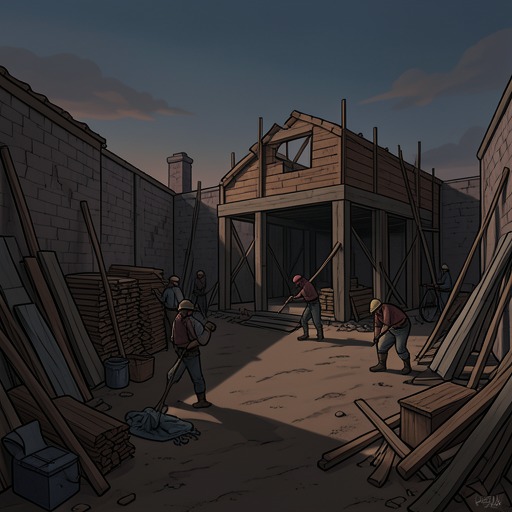
By 20 March 1866, two months into construction, the gaol-house was becoming an imposing presence. The walls were up, the chimneys had been bricked, and the fortified doors had been hung in steel frames. The speed of the work owed much to Nilssen’s £400 donation, supplemented by funds eventually released from the Westland Public Works Committee, the Hokitika Council, and the Municipal Board.
The site was still conspicuously incomplete. Lamps had not arrived; the prison kitchen had no stove; the gaoler’s cottage had no window glass; and the pit beneath the gallows had yet to be dug. Those absences place the gaol-house between a construction project and a functioning institution: its secure doors were already in place, but ordinary domestic provisions and parts of the execution infrastructure remained outstanding.
A prison already in use
Although the building was not finished, its intended occupants were beginning to arrive. George Shepard expected the felons to be moved from the Police Camp before the end of April, and several were already spending nights on the Seaview premises. Shepard himself preferred to sleep there as the work neared completion, taking his suppers cold. His presence joined supervision of the building to supervision of the prisoners; the future gaol-house was not merely being prepared for confinement but was already serving, in part, as a place of it.
The site’s workaday routine included Shepard’s physical labor. At noon, while the bell of the Wesleyan chapel sounded from the town below, he was digging an alternate pit for the latrine. When the foreman called the felons to break, Shepard climbed out of the hole and saw a young ginger-haired man waiting beyond the iron gate. The unfinished prison thus appears through a threshold encounter: Shepard rises from a practical task to meet someone seeking an interview, with the gate separating the visitor from the work and confinement within.
Shepard and the meaning of law
At that gate, Shepard tells the young man that the best lawmen can enforce the law without a badge. The remark gives the construction site a significance beyond its materials. Shepard presents law as an obligation and capacity that can exceed formal office, even as he occupies a position of authority over the prisoners and oversees a building designed to enforce the law through confinement.
Another episode makes the institutional setting part of a wider question of legal status. After Emery Staines had been absent for more than eight weeks, the Magistrate ruled that his gold-bearing claims, including the Aurora, had reverted to the Crown. Quee Long was consequently released from his obligation to work the barren claim and went to Hokitika to learn where he would be indentured next. He was assigned a claim at Kaniere and received paper proof of the transfer. The account places this legal change near Shepard’s words at the gate, setting formal rulings and documents beside the principle that law may also be enforced without a badge. It does not establish that Quee’s reassignment occurred inside the gaol-house.
Seaview’s wider associations
Seaview also enters the account of Crosbie Wells’s death and estate. In Walter Moody’s reconstruction of the tangled events, Cowell Devlin is identified as the chaplain who committed Wells’s body to its final resting place on the terrace at Seaview. The burial site is associated with Seaview, but the account does not identify the terrace as part of the gaol-house itself. Its mention nevertheless places death and burial alongside the developing institution, whose construction was being financed through a donation and public funds.
The prison’s narrative role rests on this overlap between practical construction and unsettled authority. Its progress is measured in walls, doors, missing lamps, and a yet-undug pit; its immediate use in nights spent by felons under Shepard’s supervision. At the same time, its gate frames a claim about who can enforce law, while the nearby legal world reallocates claims and obligations through rulings and documents. Seaview gaol-house is therefore both a developing piece of civic infrastructure and a setting in which the difference between law as a building, law as official judgment, and law as personal conduct becomes visible.